

Expecting mamas, have you gone down the rabbit hole searching: “What’s the best time to take newborn photos?”
If you’ve been searching for when to book your in-home newborn session, you have probably seen so many different opinions and guidelines. From the vague, “when you’re ready and it’s never too late,” to the “I don’t photograph babies after 14 days” type of newborn photographers.
And yeah, there’s wiggle room. It does depend on when you feel good, when your body is healed enough, when your baby is home and strong enough … that is all SO true.
But it also depends on science.
Up to 21 days is typically what I shoot for and for some reason, Day 8 seems to be my sweet spot.
But why does that timing matter? If everyone tells you “it’s never too late,” (which is true, in some capacity) why does your little one need to be a week old!? Because I get it, it feels really early …
Well because the ideal time for newborn photography is not just based on tradition or aesthetics. It is rooted in how babies develop in the first few weeks of life.
Understanding the science behind newborn photography timing helps you move from guessing to choosing what actually fits your baby, your recovery and the kind of images you want.

Why are newborn photos taken so early?
The reason newborn photos are typically taken within the first two weeks comes down to physiology.
In those early days, babies are still adjusting to life outside the womb. Their bodies, reflexes, sleep cycles and skin are all in a very specific and short-lived stage. (They literally aren’t sure they have made it to the outside yet, from a physiological standpoint.)
This is what makes early newborn photography not only possible, but often smoother and more comfortable for baby and family. It’s what helps them go a tiny bit faster sometimes too.
Here are some insights into what is actually happening during those first few days and weeks of your baby’s life:
Newborn Flexibility and Curl: Why Early Posing Works
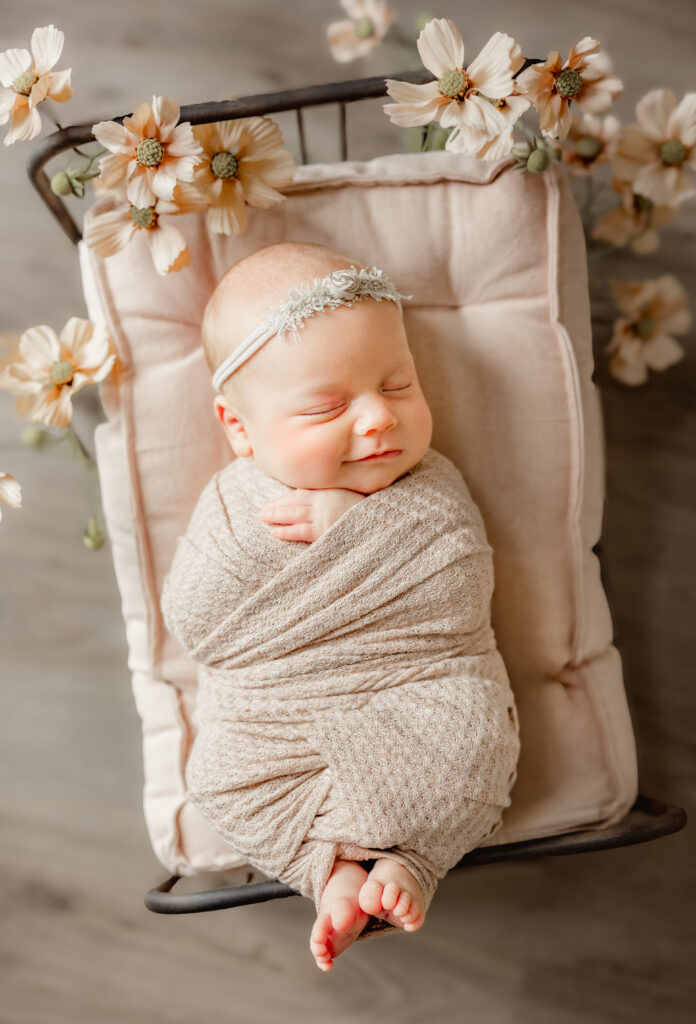
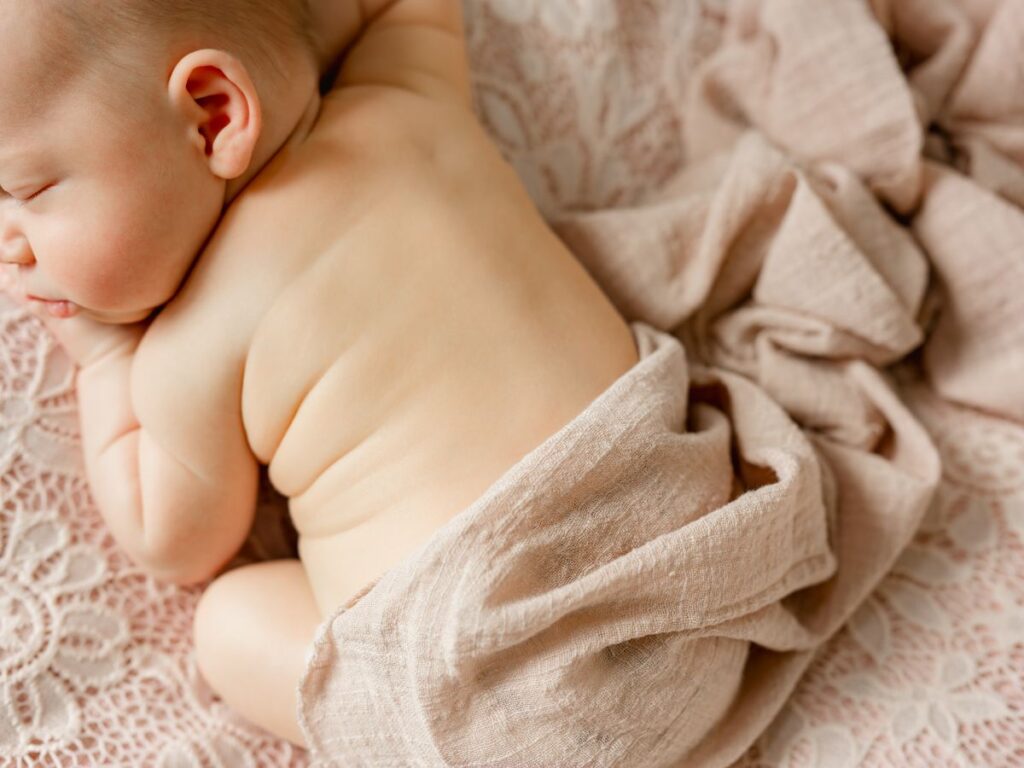
In the first 1 to 2 weeks, newborns naturally stay curled. Their little legs cross, their arms tuck up … just like they are curled up inside the womb.
After months of developing in that small space, their muscles and joints are still adapted to that tucked, rounded position. This is why posed newborn images often feature babies curled in on themselves in a way that looks natural and deeply settled.
As babies grow, their bodies begin to lengthen and stretch. That natural flexibility decreases, and those curled poses become less intuitive.
This is one of the core reasons early newborn photos allow for more posed images. The poses are not forced, they are aligned with how baby’s body already wants to rest.
Newborn Sleep Patterns: Why Babies Sleep More Deeply in the First Days
Another key factor in when to take newborn photos is sleep.
In the first days after birth, babies tend to enter deeper, more sustained sleep cycles. This allows for gentle posing and repositioning without constantly waking or startling them. (In the newborn photography world, we’ll sometimes say a baby is “touchy,” meaning any small adjustment will jostle them out of their sleep with ease, which is more often the case with older newborns.)
As babies reach 2 to 3 weeks and beyond:
- Sleep becomes lighter
- Wake windows increase
- Babies become more aware of their environment
From a newborn photography perspective, this means less uninterrupted sleep and more frequent pauses.
This is why the best time for posed newborn photos is often during that early, sleep-heavy stage.
Newborn Reflexes: Why Babies Become More Sensitive Over Time
In those first days, newborn reflexes are present but less reactive during deep sleep.
As the nervous system develops, babies become more sensitive to touch and movement. Many parents notice their baby becoming a little more alert, a little more reactive and a little harder to settle once disturbed.
This is a normal and healthy shift.
But it does impact newborn photo sessions, especially those that involve gentle posing. As sensitivity increases, babies are less likely to stay settled through transitions.
When wrapping and working with babies, you may notice that your photographer keeps a firm, gentle hand on arms and legs, keeping them curled and trying to avoid activating their Moro reflex.
Understanding babies’ reflexes is key for an experienced newborn photographer.
Feeding Patterns and Cluster Feeding: How It Affects Newborn Sessions
Feeding patterns also play a role in newborn photography timing.
Early on, many babies follow a simpler rhythm of feeding and sleeping. As they grow, cluster feeding often begins, especially around growth spurts.
During this stage, babies may:
- Feed more frequently
- Settle for shorter stretches
- Need more time to regulate
For photography sessions, this can mean more breaks and a less predictable flow.
The early newborn window tends to offer longer, sleepier stretches between feeds, which supports a smoother session experience.
Typically, in a 2 – 3 hour Atlanta in-home newborn session, I will ask parents to feed their baby as I setup – into a deep, settled sleep – we’ll move through a few poses then when we unwrap, we’ll feed once more, again back into a deep sleep.
Newborn Skin Changes: Why Early Photos Capture That “Fresh” Look
One of the most overlooked parts of when to schedule newborn photos is skin.
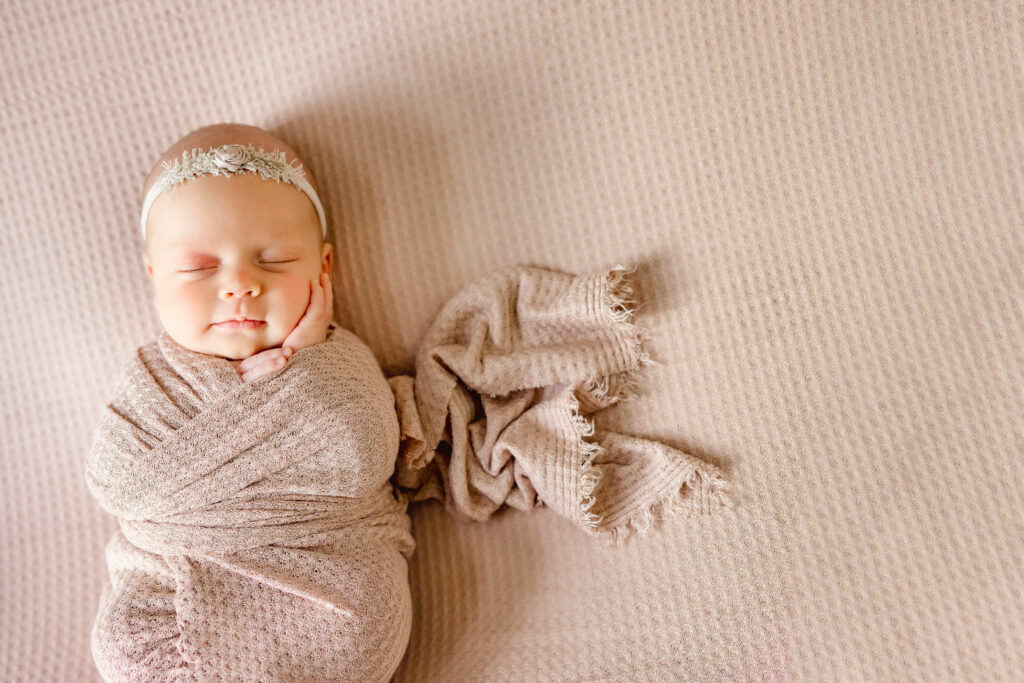
In the first days after birth, baby’s skin is often at its most even and clear. Shortly after, many newborns begin to experience:
- Baby acne
- Dry or peeling skin
- Redness as they adjust to the environment
This is completely normal.
But it is part of why the classic “fresh newborn” look is most often captured in those early days.
And I’ll be blunt here, the time difference in editing a session of an 8 day old baby versus a 3 week old baby is hours and hours!
What This Means for the Best Time to Take Newborn Photos in Atlanta and Beyond, In-Home or In-Studio
When photographers recommend scheduling newborn photos within the first 5 to 14 days, it is not about rushing you.
It is about working with:
- Newborn flexibility and natural curl
- Deeper sleep cycles
- Lower sensitivity to movement
- Simpler feeding rhythms
- Early-stage skin
All of these factors combine to create the ideal window for posed newborn photography.
So am I too late to get newborn photos?
This is one of the most common questions parents ask when researching when to take newborn photos.
And the answer is no, it is not too late.
But it is different.
At 2 to 6 weeks:
- Babies are more alert
- Sleep is lighter
- Posing is more limited
- Connection and interaction take center stage
This is where sessions shift from posed newborn photography to a more relaxed, lifestyle approach.
Some babies can be gently posed older than others, and an experienced Atlanta newborn photographer will be able to understand baby’s queues and physiology to determine what’s possible without force or discomfort.
Final Thoughts from an Atlanta Newborn Photographer on When is the Best Time to Take Newborn Photos
My personal take: As early as you’re comfortable taking them, with the understanding that timing does make a difference in the look of your images.
The reason early newborn sessions are recommended is not because they are “better.”
It is because, for a short window, your baby’s body, sleep and rhythms make certain types of images possible.
That window passes quickly.
And understanding the science behind the best time for newborn photos allows you to choose your session timing with clarity and confidence, instead of pressure.
Because at the end of the day, the goal is not just beautiful images.
It is an experience that supports you in this season, exactly as you are.
Just as important as timing your newborn session is selecting an Atlanta newborn photographer who understands these things AND is a good fit for your family. Hop over to my Newborn Sessions page and read about my approach and if you’re ready for an in-home newborn session that’s safe and aligned with the rhythms of your family and your baby, I’d love to hear from you – you can inquire here.
And if you’re expecting and planning maternity photos soon, hop over to my friend Emily’s post about what to wear for summer maternity photos – she has lots of great advice.



These images are absolutely stunning!
Aw thank you, such a beautiful family ~ they made it easy!
You’re so right about that 2-week window and how it naturally shifts things from more posed newborn photography to a lifestyle approach. I really appreciate how clearly you explained the reasons the first two weeks are considered ideal for newborn sessions—it was so helpful and thoughtful.
It really does, and I love a lifestyle session and that they can be well suited for our older babies (if a month can be seen as “old” 🙂 But for those families really in love with the curly, sleepy, posed ones … we try to get to their sweet babies pretty quickly.
I do find that at 3 weeks babies are much more awake! Not a bad thing by any means but you are much more likely to get the bundled up sleepy photos at 8-10 days!
8 days! I don’t know what it is, but it seems all my 8 day old babies are just unicorns – so sleepy and content. It really is never too late, but it does change the vibe and what can be safely achieved as they get a bit older when it comes to in-home newborn photography. Or studio newborn photography for that matter!
Love how practical this is to know what to expect and why choose when you want to do your photos at certain times!
Yay, good! Yes, I wanted it to be really informational and not emotional. I think as new moms, we’re already in the thick of an emotional season so just thinking logically – what do I prefer in the look and feel of my newborn photos – and letting that dictate the ideal time to book, is really helpful.
Amazing! My nerdy brain loved all these science facts and exploring the “why” behind the best windows for newborn photoshoots. How helpful for parents to know and then be able to select the timing and the type of photos that will mean the most to them!
Good, I’m glad! It can feel really early so I find it helpful for mamas and parents to know why we try to snag that window if everyone is here and healthy 🙂
This is such important info for expecting mamas! That sweet, squishy, newborn stage goes by so quick.
We love our older babies with their wide open eyes and sweet little smirks starting to appear. But when asked “why do we take newborn photos so early?” I always want to make sure parents know it’s not *just* my preference. That true newborn stage does go by so quickly, you’re 100% right!
Great content! Keep up the good work!